Security measures are built into the process to create software that is more secure in every respect.
For every type of communication need, there is a right tool capable of simplifying the work and boosting results even further.
When we talk about automation software, we mean the many possibilities for improving a process (production, service delivery, sales, etc.) by replacing repetitive, bureaucratic tasks performed by people with integration into a system, making them automatic.
There are many practical examples, such as BPM software for process automation, marketing automation or even integrations via APIs (Application Programming Interfaces) to automate tasks.
And to make all the software options work together and in line with corporate goals, you need to pay attention to the importance of integrating systems within companies.
The first step toward good integration is defining the project's objectives.
To make sure they are the best possible, you need to listen both to the managers of the areas involved and to the employees who use the systems to be integrated every day.
Only with a good understanding of how value is generated in these communication systems and what problems the team faces is it possible to move on to the next stage: planning.
When planning systems integration, it is recommended to first design abstract solutions for the tools and show all stakeholders how they would work in practice before rolling up your sleeves and moving to execution.
Only when this initial planning has been approved and understood by everyone is it worth starting the technical work on the systems.
What Are the Advantages of Software Automation and Integration?
Systems integration has a big impact on employees' daily work and on business management itself, since it simplifies the administration of the business and its departments.
Workflows are optimized, routines become more dynamic and processes are carried out collaboratively by workers from different areas. In addition, there are other advantages such as:
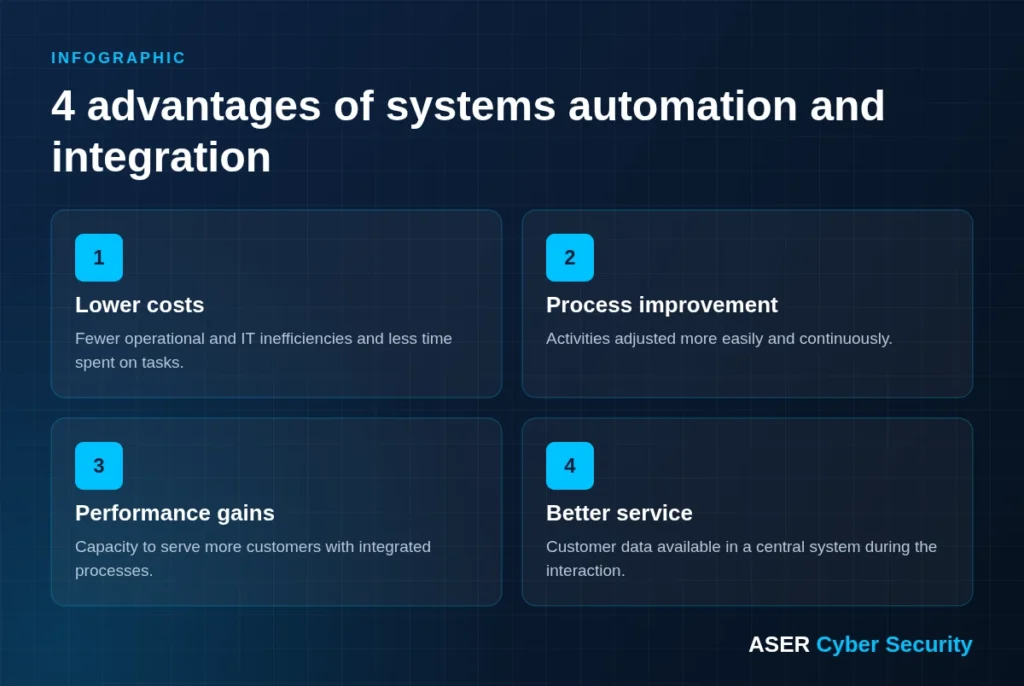
Lower Costs
Eliminating operational and IT inefficiencies leads to a steady reduction in budget costs, and a good part of them can be cut.
Automated processes also reduce the time spent on organizational activities, which generates savings.
This way, managers can use the saved resources for more critical investments that improve the quality of customer service.
Process Improvement
Continuous process improvement is a fundamental requirement for any company that wants to survive in the market in the long term, stay competitive and succeed.
With good systems integration, this frequent optimization becomes simpler, because activities and tasks can be changed more easily with technological support.
Performance Gains
Having automated and integrated processes is essential for the company to be able to serve all of its customers and potential consumers. In this context, organizations with greater collaboration between departments stand out, which leads to higher revenue and a high level of innovation.
When internal communication is strengthened, it can optimize relationships and promote jointly defined strategies, as well as more efficient work routines. All of this translates into greater team productivity.
Better communication and data delivery to customers
One benefit of systems integration in companies is better customer service and communication with the public.
This happens because it becomes easier to access data while interacting with consumers, since you only need to log into the central system to check items such as:
- Purchase history;
- Number of service interactions;
- Registration data;
- Payments made or outstanding;
- Length of relationship with the company;
- Sales process progress;
- Exchange and cancellation procedures, etc.
For all this to work well, it is important to hire an external company for the task.
If so, make sure they understand the company's real needs and can deploy scalable systems integration, providing support and training throughout the process.
Secure integration starts with testing
Before connecting systems and APIs, ASER Penetration Testing checks that the integrations don't open gaps for attackers.
Do you have any questions about the challenges of systems integration in companies?
Talk now to one of our specialists so we can help your company!
Want to integrate your systems without opening gaps?
For more than 20 years, ASER has protected Brazilian companies with 100% managed security. Talk to an expert and get a free assessment of your business risks.