
Scanners point out possible flaws. A penetration test answers what really matters: can this flaw be exploited? What could an attacker access? Do your current controls block the attacks you worry about most? ASER's Penetration Testing simulates real attacks against your applications and APIs, within a scope authorized in writing, to show in practice the risk of each vulnerability and what to fix first.
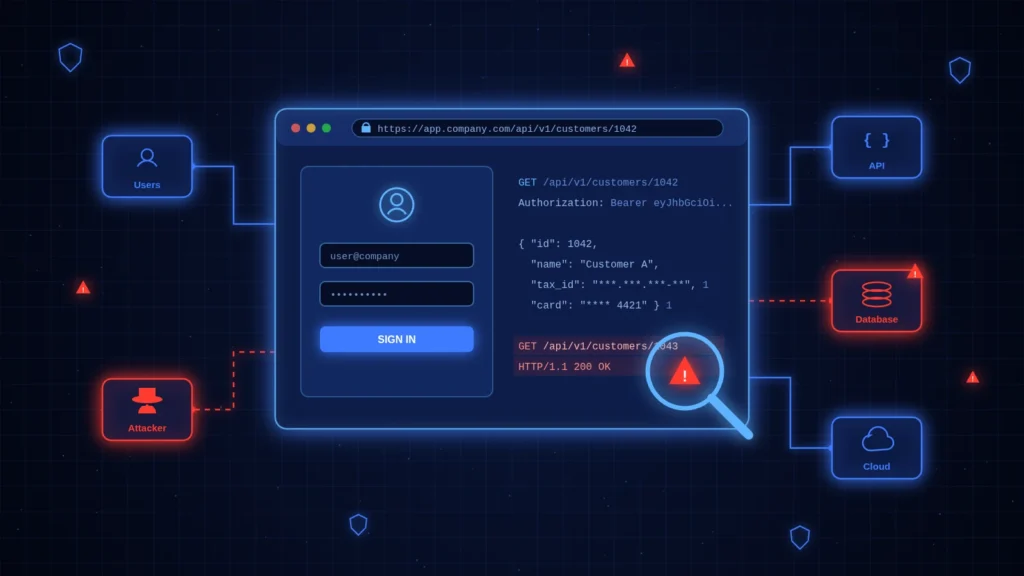
A penetration test, or pentest, is an assessment in which specialists take an attacker's perspective and try to exploit, in a controlled way, the vulnerabilities of a system.
The goal is not to hand over a list of alerts, but to prove what is exploitable, how far exploitation goes and what the impact is on operations, data and customers.
The test can be performed without credentials (black box), with test users of different profiles (gray box) or with access to documentation and code (white box), depending on the agreed objective.
For specific environments, ASER also offers Network Pentest, Mobile Pentest and E-commerce Pentest.
The assessment may include:
A good test starts with the questions the company needs to answer — for the board, for auditors or for its own customers.
An isolated vulnerability may seem low-impact. Combined with an authorization flaw or a weak credential, it can expose your entire customer base.
At the end of the test, you will know:
Tests are carried out by professionals who analyze the application from an attacker's perspective, combining specialized tools with manual exploitation. Team certified in OSCP, CEH and eWPT.
We don't just deliver a technical score. We explain how each flaw would affect customers, data, revenue, reputation and business continuity.
Testing follows references such as the OWASP Web Security Testing Guide, OWASP Top 10, OWASP API Security Top 10 and PTES, with techniques mapped to MITRE ATT&CK where applicable.
We test what scanners can't see: access to other users' data, privilege escalation between profiles, and abuse of workflows and business rules.
Each project is planned around the architecture, technologies, integrations and access profiles of the application under test.
Findings can flow into our Vulnerability Management and SOC services, which track remediation and tune detection.
We define objectives, applications, APIs, access profiles, time windows and exclusions. Nothing is tested without written authorization.
We identify technologies, endpoints, exposed surfaces, authentication flows, integrations and possible entry points.
We use specialized tools to support the initial discovery of vulnerabilities, misconfigurations and exposed components.
Specialists validate the findings and perform manual testing of exploitation, authorization, authentication, sessions, APIs and business logic.
Each vulnerability is analyzed considering how exploitable it is and its technical and business impact on the company.
We deliver an executive overview, technical details, evidence and a prioritized remediation plan, and present the results to the teams involved.
No test starts without formal authorization from the environment owner. Out-of-scope systems are never touched.
Assets, techniques, time windows and what is excluded are recorded before we start, so there are no surprises.
If there is unexpected impact or any sign of a real incident in progress, testing stops and you are notified right away.
One person in charge at ASER and one at the customer, with a direct escalation channel throughout the engagement.
We collect only what is needed to prove each finding, with agreed retention and disposal periods.
After fixes are applied, a retest confirms that each flaw has really been eliminated, when included in the scope.
Where are my weaknesses and which should I fix first? Continuous scanning, risk-based prioritization and remediation governance.
Is this flaw exploitable, and what is the impact? Controlled exploitation of applications and APIs, with evidence and a remediation plan.
How far can an intruder get in my network? Internal and external infrastructure testing, segmentation and lateral movement.
Does my team detect and respond to a real attack? Adversary simulation with defined objectives, measuring detection and response.
What do I have exposed on the internet without knowing? Continuous discovery of exposed assets, services and domains.
Do my employees fall for scams? Phishing, SMS and phone-call simulations, with training at the moment of failure.
A scan uses automated tools to point out possible vulnerabilities, outdated components and misconfigurations.
A penetration test validates those findings manually, exploits them in a controlled way and shows the real impact — including when small flaws combined open an attack path.
Black box: the specialist starts with no credentials or internal information, like an external attacker.
Gray box: the specialist receives test users with different profiles, to assess authorization and what a malicious customer or employee could do.
White box: the specialist has access to documentation, architecture and, if agreed, source code, which increases the depth of the analysis.
Tests are planned to preserve availability.
Before we start, we define rules of engagement, time windows, critical assets and an immediate stop channel. Techniques that could cause downtime are only used with specific authorization.
A penetration test is important evidence for these requirements. PCI DSS requires periodic penetration testing (requirement 11.4), Brazil's LGPD calls for technical security measures appropriate to the risk, and CMN Resolution 4,893 provides for tests and scans to detect vulnerabilities.
On its own, however, a test does not guarantee compliance: it proves the security posture on the assessment date and guides remediation.
At least once a year and always after relevant changes, such as new features, integrations, a platform change or an infrastructure migration.
Just tell us:
Do not send passwords or credentials at this stage. They are exchanged securely after formal authorization.
Talk to a specialist to define the scope of your test and receive a proposal.