Most attacks start with a convincing message sent to a person. Many companies invest in firewalls and EDR but forget the human factor. Our platform simulates real phishing, smishing and vishing attacks, measures employee resilience and delivers training at the moment of failure, turning people into your first line of defense.
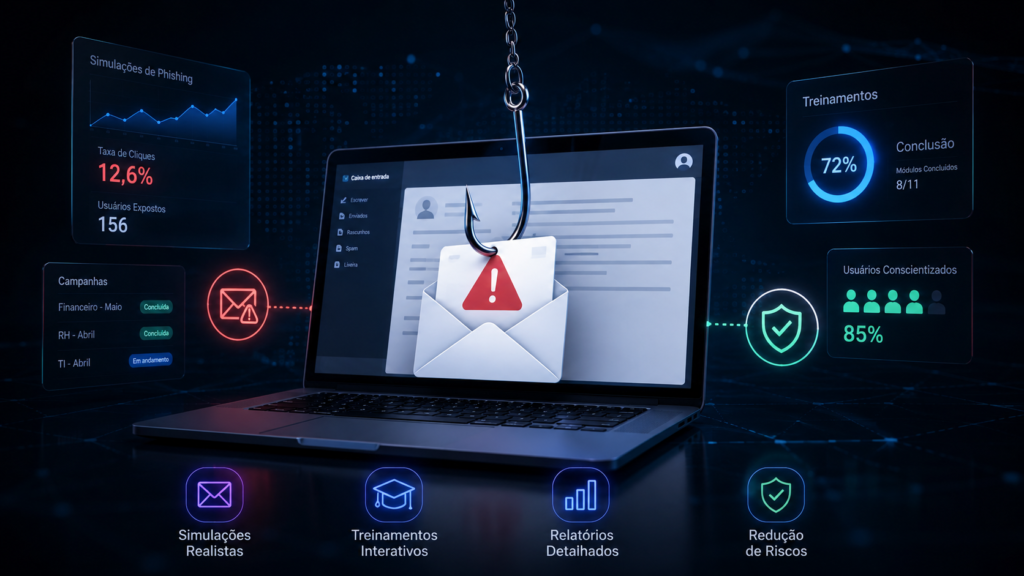
A phishing testing platform is a technology solution that lets companies simulate social engineering attacks — by email (phishing), SMS (smishing) and phone calls (vishing) — to measure employee resilience and train them in a practical, contextual way.
Unlike theoretical, once-a-year training, phishing simulation creates real learning experiences. When an employee clicks a simulated malicious link, they receive immediate micro-training explaining why they fell for it and how to spot warning signs in the future.
ASER offers a complete security awareness training platform that goes beyond simple email campaigns. Our scenarios include:
The human factor remains the attack vector most exploited by cybercriminals. Advanced technology doesn't replace the need for aware, prepared employees.
Phishing templates customized for finance, HR, legal, IT and operations. We use the language, senders and contexts your employees would actually see day to day.
Simulate attacks by email, SMS and phone calls. Attackers don't use just one channel — your defense shouldn't either.
Whoever clicks isn't punished — they're educated. 2–3 minute micro-trainings explain the scam, show the warning signs and reinforce safe behavior.
Set up recurring, seasonal (Black Friday, tax season) or one-off campaigns. The platform sends, measures and reports automatically.
Training evidence for LGPD, ISO 27001, PCI-DSS and cyber insurance. Export supporting reports in one click.
Sync users automatically. Segment by department, role, location and risk level. No manual CSV work.
Email phishing campaigns with realistic templates, simulated landing pages and full tracking of opens, clicks and entered credentials. Includes personalized spear phishing.
SMS messages impersonating banks, deliveries, 2FA and promotions. Measures employees' tendency to click mobile links and install malicious apps.
Automated calls impersonating technical support, financial institutions and coworkers. Tests resilience against voice-based social engineering.
A library of microlearning, videos, quizzes and gamification. Content updated with real current threats. Completion certificate per employee.
Baseline tests, follow-up campaigns and progress reports. Identify the most vulnerable employees and departments and target training.
Executive reports in business language, training evidence for audits and ROI dashboards. Justify your security investment with data.
Every campaign is approved by the company, with alignment between security, HR and legal before the first send.
Groups, channels and themes are defined in advance. Themes that could cause harm or embarrassment are left out.
Senders and simulated pages are allowlisted together with IT, so the campaign is not mistaken for a real attack.
Whoever falls for the scam gets guidance on the spot. The goal is to change behavior, not to expose employees.
We record only what is needed to measure the campaign, and results for management are presented in aggregate.
Recurring campaigns show progress by department and indicate where to reinforce training.
Where are my weaknesses and which should I fix first? Continuous scanning, risk-based prioritization and remediation governance.
Is this flaw exploitable, and what is the impact? Controlled exploitation of applications and APIs, with evidence and a remediation plan.
How far can an intruder get in my network? Internal and external infrastructure testing, segmentation and lateral movement.
Does my team detect and respond to a real attack? Adversary simulation with defined objectives, measuring detection and response.
What do I have exposed on the internet without knowing? Continuous discovery of exposed assets, services and domains.
Do my employees fall for scams? Phishing, SMS and phone-call simulations, with training at the moment of failure.
A phishing testing platform is a SaaS solution that simulates social engineering attacks (email, SMS, calls) to measure employee resilience and train them with contextual microlearning. Unlike theoretical training, simulation creates real learning experiences.
Yes. Simulated emails install nothing and cause no harm. The platform records only the interactions needed to measure the campaign, and whoever falls for the scam receives educational guidance, not punishment.
The goal is to educate, not to expose. Campaigns are agreed with the company and comply with the LGPD.
The first campaign can run right after setup and already shows your baseline click rate.
The reduction shows up over regular campaigns, and the platform tracks that progress month by month, by department.
Yes. The platform generates training evidence for LGPD, ISO 27001, PCI-DSS and cyber insurancerequirements. Supporting reports on campaigns, engagement rates and team progress can be exported for audits.
The ASER platform supports phishing (email), smishing (SMS) and vishing (calls) in a single solution. You can run standalone campaigns or combined campaigns that simulate multichannel attacks — the most realistic and effective way to test resilience.
At the moment of the click, the employee is redirected to an educational page that explains why that email was a scam, which warning signs they missed and how to spot similar attempts in the future. The content is a 2–3 minute microlearning — fast, practical and without disrupting productivity.
Schedule a diagnostic campaign and learn your company's click rate.