
Digital wallets are a technology that has enabled countless advances, but as a consequence it has also allowed hackers to get around and attack systems.
Mobile digital commerce has grown at a staggering pace in recent years.
Which in a way should come as no surprise, considering that a large share of global web traffic originates from mobile devices.
This shows that portable devices have played a significant role in shaping modern shopping behavior, and innovations such as digital wallets have completely revolutionized the customer experience.
After all, they are easily accessible, secure, convenient and provide a practical way to make payments.
In this article, we discuss several details about digital wallets, including how they work, why they are popular and how you can protect your business against fraud.
What is a digital wallet?
A digital wallet (e-Wallet) is a piece of software equivalent to a physical wallet that carries your money.
It can be operated from your computer, smartphone or mobile device, eliminating the need to carry cash.
Once you load your credit card information into the digital wallet app, you can pay for your purchases with it, both online and offline.
Even when you shop in physical stores, Near-Field Communication (NFC) technology lets you check out using your digital wallet at the point of sale. Currently, the most popular options on the market are:
- Apple Pay. The digital wallet for iPhone, iPad and Apple Watchusers. Its security features are top-notch, and users can verify payments using Touch or Face ID.
- Google Pay. Anyone with an Android operating system can use Google Pay. Customers can pay with a fingerprint or a password, and transactions are protected by encryption.
- Samsung Pay. This e-wallet is most popular among Samsung users; it uses Magnetic Secure Transmission (MST) and NFC for in-store payments.
How do digital wallets work?
A digital wallet emulates a real, physical wallet, keeping cash or credit at hand for everyday payments.
Digital wallets use the information from a user's debit or credit card, which is encrypted to prevent misuse. After setting up the account, only the customer can access the wallet by entering valid login credentials.
This makes the digital wallet device-independent. Even if a user loses the device, no one else can access their wallet.
On the other hand, an authorized user can access and use their wallet from any other device.
To make a payment, customers hold their mobile device close to the card reader at a retailer's point of sale.
A contactless payment symbol is usually visible at these establishments, indicating that the store accepts digital wallet payments. Once the payment is authorized, the amount is quickly transferred to the merchant.
The growing adoption of digital wallets by businesses.
The pandemic has been one of the biggest drivers of this trend. COVID-19 required social distancing and discouraged cash payments in stores.
Advances in technology and high-speed internet have made it possible to host and run these payment instruments seamlessly.
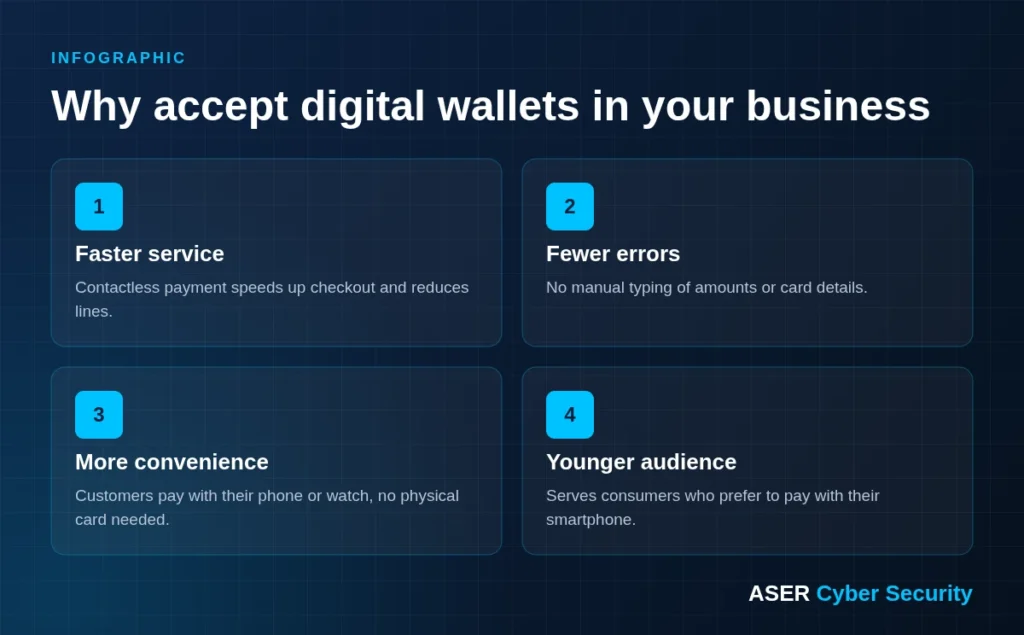
In addition, digital wallets also offer several benefits for merchants. Here are some of them:
- Faster service.
Waiting in long lines is a nuisance for most shoppers.
Customers may even avoid your store if check out takes too long.
According to data from the research institute emarketer , 32% of American customers would look for a more convenient check out experience if the line were too long, while 11% said they would abandon a purchase altogether.
Digital wallets can help you serve customers faster, increasing satisfaction and preventing lost sales.
- Fewer errors.
Sometimes your cashier may enter the wrong amount on the card reader.
Overcharging customers creates a negative experience, while undercharging can result in lost revenue.
Digital payments can help prevent this by keeping payments error-free, especially if you use integrated payments.
Digital wallets are not only a much safer option than handling cash or physical cards, they also provide a high degree of security.
Because they come with built-in authentication and encryption features, merchants take on less risk with these transactions.
- Convenience.
In March 2021, according to statista, 80% of online shoppers abandoned their carts without completing their purchases.
And one of the biggest reasons for this is friction at check out.
Entering card information on mobile devices can often be inconvenient, even more so if the web page isn't optimized.
Digital wallets offer a smoother alternative, letting customers move quickly through the check out.
- Targets the younger demographic.
Old payment methods can be a deterrent for new-generation shoppers.
Since these groups hold significant purchasing power, serving them requires tech savvy.
Digital wallets can help you with exactly that.
Implementing fraud protections for digital wallets.
With everything we've said above in mind, you need to use systems and take precautions so you don't become a victim of fraud.
See our recommendations below.
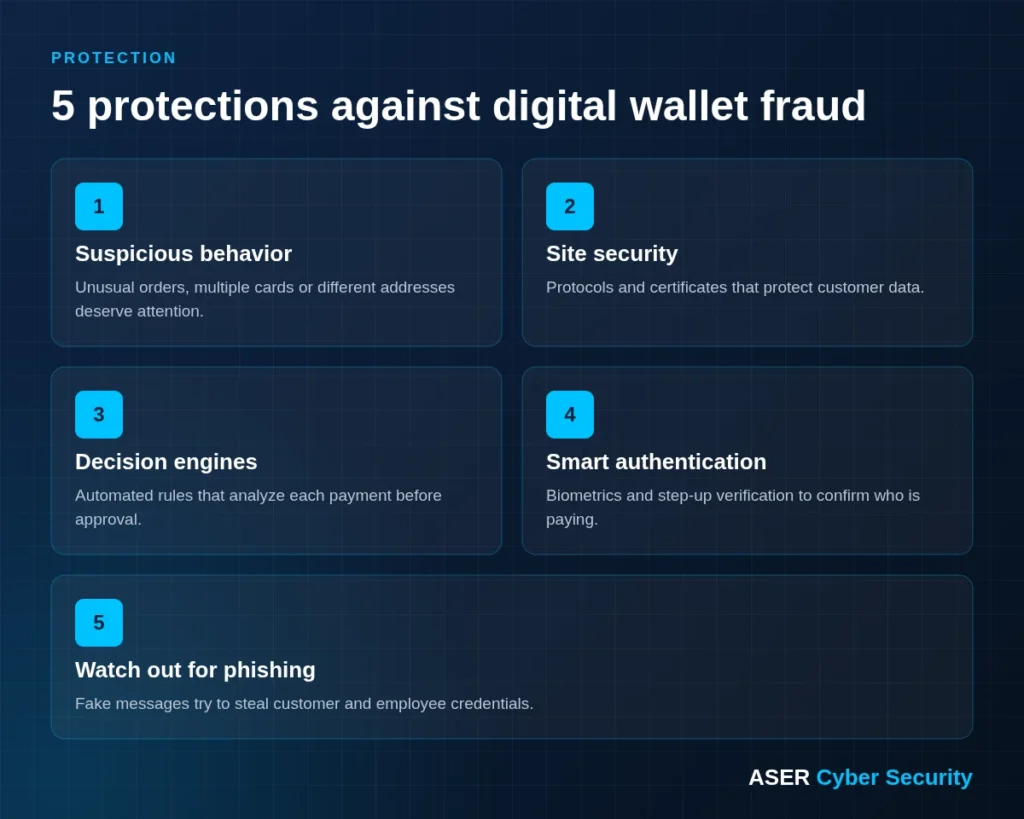
Suspicious behavior.
Fraud prevention platforms include components focused on detecting fraud patterns.
One example is a first-time buyer who places an unusually large order.
That alone would describe the typical behavior of someone using a stolen credit card.
But if a consumer uses different payment methods for orders shipped to the same address, you need to be alert.
Also, be careful with large orders with foreign shipping addresses.
International laws make it harder to fight fraud successfully.
Protocols to verify site security.
Consumers are increasingly comfortable shopping online and using payment information stored in their digital wallets.
That's why, to protect your customers' information, use the “HTTPS” protocol to make your transactions more secure.
Decision engines to analyze payments.
Inaccurate fraud detection systems approve bad transactions and decline valid ones.
This way, you lose money to fraud and may lose customers due to false declines.
That's why you should invest in a system that checks the relevant purchase details.
Choose a solution that, for example, passes this information to an open application programming interface framework.
This approach uses a wide variety of shopping cart plug-ins for decision engine analysis. It analyzes order, device and payment information. Cardholder data and session behavioral attributes are also analyzed.
Smart authentication features.
It's easier to make correct decisions about transactions when you have more data.
For example, protection solutions with transparent data collection provide more information about the user's device.
Reliable platforms use decision engines together with supervised and unsupervised machine learning . Together, they can evaluate two trillion transaction-related data points. This provides the best and most accurate determination and reduces fraud.
Can your checkout withstand a real attack?
The ASER E-commerce Pentest simulates attacks on your site, app and payment methods to find flaws before fraudsters do.
Don't fall victim to phishing.
Scams involving phishing through malicious ads and emails are common in the world of e-commerce and cryptocurrencies. So be careful when making online transactions and avoid suspicious and unknown links.
During a recent event, a hacker group called “CryptoCore” targeted cryptocurrency exchanges through spear phishing.
campaigns. The attackers stole the equivalent of US$200 million over two years, targeting companies in the US and Japan.
The ClearSky stated that CryptoCore started a reconnaissance phase to identify the email accounts of employees and security executives at the cryptocurrency exchange before carrying out a spear phishing attack.
These attacks were carried out using fake domains impersonating organizations and affiliated employees, embedding malicious links in documents sent by email.
???? Phishing is the gateway to fraud. Prepare your team to recognize scams with the ASER Phishing Platform.
Digital wallets vs. cryptocurrency wallets
The idea behind digital wallets and cryptocurrency wallets is the same.
After all, both allow easy payments using digital currency and eliminate the need to pay in cash or enter card details repeatedly, but the two solutions are still quite different.
A digital wallet stores the same currency you would carry in your wallet (in physical form).
Cryptocurrency wallets, on the other hand, store the keys needed to buy and sell cryptocurrencies.
Customers can pay using conventional currency (in a digital wallet) at most stores. However, cryptocurrency wallets can only be used at a very limited number of stores that accept this type of asset.
A digital wallet stores cards and currencies that are covered against fraud by the credit guarantee fund (FGC). Cryptocurrency still operates in an unregulated economic sector that is not covered or authenticated by any financial institution.
How to start accepting digital wallets in your business?
Digital wallets are quickly becoming indispensable for merchants who care about providing a seamless shopping experience for their customers.
The easiest way to start accepting them is with a fully integrated card reader.
These devices work as complete solutions that eliminate the need for separate displays, scanners and cash registers for the different types of payments customers make.
Finally, digital wallets are a popular online payment method because they are secure and convenient.
Digital wallets also help reduce shopping cart abandonment and increase conversions because they offer seamless check out solutions.
The numbers are clear: consumers are increasingly adopting digital wallets, both online and in stores.
So, are you prepared for this new trend?
If your company doesn't update and prepare for these new trends, it may become outdated, making it easier for your business to fail.
But don't forget to make sure you use security systems that keep your business from suffering attacks or falling victim to fraud.
With that in mind, you can count on one of our specialists to help you.
Want to sell with digital wallets without opening security gaps?
For more than 20 years, ASER has protected Brazilian companies with 100% managed security. Talk to an expert and get a free assessment of your business risks.