Both terms are on the lips of cybersecurity professionals, but even among them they cause confusion; the concepts of IAM and CIAM are similar but have important differences.
You're surely tired of hearing that, with accelerated digital transformation and the rapid digitalization of service and product delivery — driven above all by the crisis of the last two years — the focus of cybersecurity professionals has shifted from the network perimeter to user identity.
After all, there is no longer even a perimeter to protect: your employees and customers are spread out, using many devices to access information and applications.
In this scenario, digital identity becomes more important than ever, because it ensures that the person trying to access certain content really is who they claim to be, and not a cybercriminal who stole their credentials. That's why we're hearing more than ever about two similar terms that, for many professionals in the industry, are the same thing: IAM and CIAM.
If you're one of them, know that you couldn't be more wrong!
What are IAM and CIAM?
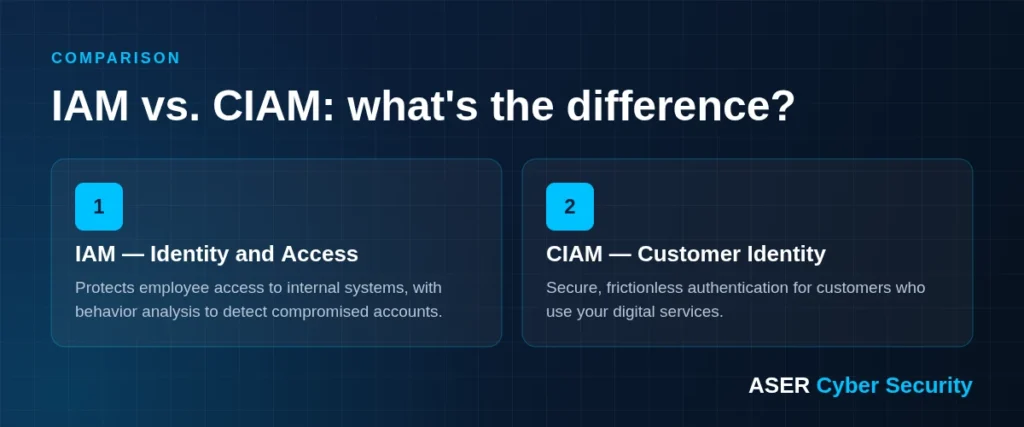
IAM stands for Identity and Access Management.
It is the set of practices and tools (solutions, frameworks, etc.) that aim to manage your company's employees' digital identities more efficiently, ensuring they only have access to what is essential for their work.
IAM solutions can usually use behavioral analysis to identify whether an employee's account has been compromised, for example.
And CIAM?
Well, the “C” stands for Customers. CIAM solutions therefore aim to provide a more pleasant authentication experience for your customers, which is important, for example, for internet-only banks, social networks, online stores and so on.
CIAM aims to balance security, reliability and a frictionless experience — in other words, as friendly and easy as possible for the customer.
Which one is more important?
Both!
While IAM ensures internal security in your corporate ecosystem, CIAM puts your company at the forefront of digital transformation by protecting the customer's digital identity while sparing them tedious processes such as filling out long sign-up forms and having to remember passwords.
Control who accesses your network
The ASER NAC authenticates users and devices before granting access and applies profile-based policies.
With these security models making access easier for your employees and customers, it is clear that the security of their information is in your hands.
You must make the best possible decision to ensure everything goes as planned without attacks.
You can count on Aser Security, a company focused on bringing security solutions to your systems.
Talk to one of our specialists and ensure the security of your company's information!
Is your company's digital identity protected?
For more than 20 years, ASER has protected Brazilian companies with 100% managed security. Talk to an expert and get a free assessment of your business risks.