
Ransomware attacks are increasingly frequent, and if your systems are not LGPD-compliant when you suffer this type of attack, it can bring damage and heavy fines to your company.
Today, almost every business sector depends on digital technologies.
IT infrastructure and best practices, if not updated regularly, age and become more susceptible to attacks.
Therefore, because of the amount and type of information they hold, companies become targets of cyberattacks.
According to Tech Republic, in 2018 malware attacks topped the list of the most popular cyberattacks in the world; this happens when cybercriminals steal data from victims' computers, usually using some kind of spyware.
Next on the list, hacking, happens when a criminal takes advantage of vulnerabilities in the target's software and hardware . Hackers currently do the most damage to governments, banks and cryptocurrency platforms, as we'll see below.
Main cyberattacks that happen online.
In 2019, for example, German Chancellor Angela Merkel's Twitter account was hacked and her personal information leaked.
The incident can be read as a warning that even employees in powerful positions or public figures of any kind need to be aware of the risks.
Other attacks that have gained popularity in recent years are:
- Credential theft attacks.
Corporate credential theft is usually a targeted effort.
Attackers comb social networks such as LinkedIn, looking for specific users whose credentials will grant access to critical data and information.
The effectiveness of credential phishing depends on human interaction to deceive employees, unlike malware and exploits, which rely on weaknesses in security defenses.
- Web attacks.
When cybercriminals try to extort administrators of profitable online businesses, sometimes threatening to steal customer databases or take the website down.
- Denial-of-service attack (DDoS).
The weapon of choice for business rivals, dissatisfied customers and hacktivists.
These attacks often hit government institutions, and political events are one of the main drivers.
A DDoS overwhelms a system's resources.
A DDoS attack is also an attack on system resources, but it is launched from a large number of other host machines infected with malicious software controlled by the attacker.
Criminals often carry out DDoS attacks for profit, taking websites offline and demanding payment from victims to stop the attack.
This is a form of hacker attack called Ransomware.
According to Europol, ransomware attacks have decreased compared to previous years, but they remain the biggest malwarethreat, since ransomware code is increasingly advanced and harder to detect and/or defeat.
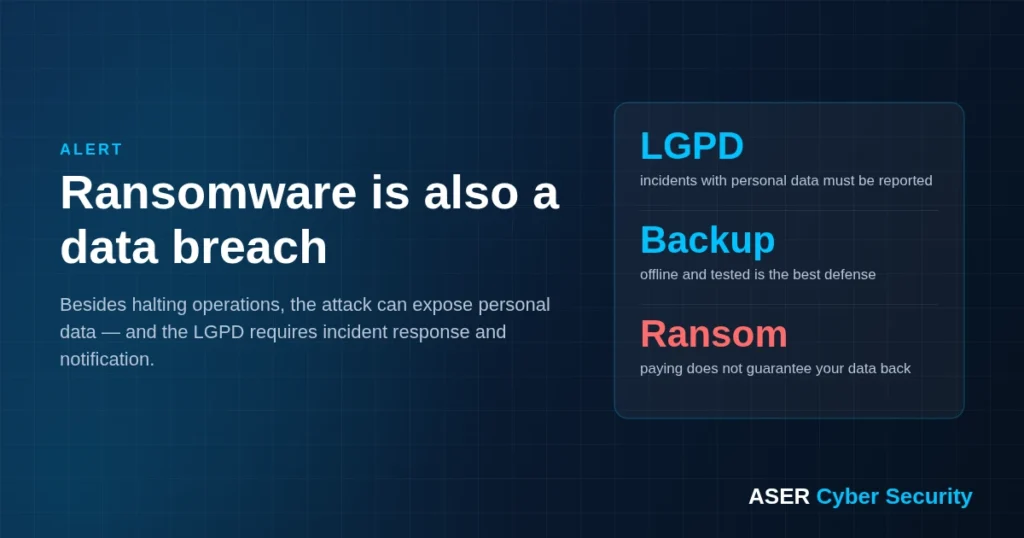
But how does Ransomware relate to the LGPD?
Ransomware is a type of malicious software that threatens to publish the victim's data or permanently block access to a database.
To restore access, the attackers demand a ransom payment.
The damage caused by ransomware is as follows:
- Temporary or permanent destruction of confidential information;
- Disruption of operations due to network lockdown;
- A demand to pay the ransom to restore the system and files.
This illegal disposal of company data can pose a risk to the rights and freedoms of the personal data subjects whose information the company may hold.
Therefore, ransomware attacks can be linked to the LGPD and treated as data breaches.
While trying to meet LGPD requirements, many companies ignore the threat of ransomware.
During the attack, the company's servers, desktops and laptops may be affected. The company must assess the data breach and possible damage.
An assessment must be carried out to determine whether personal data was compromised.
If so, the local data protection authority must be notified within 72 hours.
The breach report must include the type of attack and the amount of personal data affected, including the actions taken and planned to eliminate the consequences.
In the case of a serious breach, the personal data subjects whose information was compromised must also be notified.
Thus, companies that process confidential data must inform the local data protection authority about the incident, regardless of the severity of the breach caused by the attack.
But if the attacked company cannot prove LGPD compliance, it will be forced to pay fines.
A ransomware — does it qualify as a data breach?
The most sophisticated attackers try to calculate the fine a company would face under the LGPD before issuing their demands.
And so they set their ransom demands below the penalty the victim would face.
Attackers hope victims will prefer to pay the ransom and never report the incident, instead of informing the local data protection authorities, since that would start an investigation and possibly uncover more LGPD violations, leading to more fines for the company.
On the other hand, companies may recognize that receiving a fine is less risky than quietly breaking the LGPD and sweeping a ransomware incident under the rug.
Especially when it can be argued that a ransomware attack does not qualify as a breach and does not need to be reported (that is, no personal data was stolen, altered or destroyed during the attack).
Detect ransomware before encryption
The ASER 24×7 SOC monitors endpoints, servers and the network to identify the attack early and contain the threat before data is held hostage.
How to prevent ransomware?
Data protection specialists expect an increase in ransomware attacks in the coming years.
After all, any company, regardless of size, can be attacked.
Attackers know that receiving an LGPD fine can be fatal for smaller companies.
Therefore, it is crucial to make sure the network is strongly defended to prevent ransomware attacks or any other LGPD violations.
The main methods of preventing ransomware include:
- Updating the software on all machines frequently;
- Buying a well-regarded antivirus program in the cybersecurity market.
With the right tool, attacks can be blocked and kept from spreading, protecting the system against infection;
- Moving data to the cloud.
Clouds usually have adequate security measures to protect data and meet LGPD requirements;
- Enforcing passwords. A long, strong password makes it difficult for an attacker to access any account;
- Keep your backups of data offline up to date;
- Remove unused service accounts.
Staff training should follow the implementation of these steps, so people understand what these methods do and why they were implemented, as well as what ransomware is and how the incident should be reported.
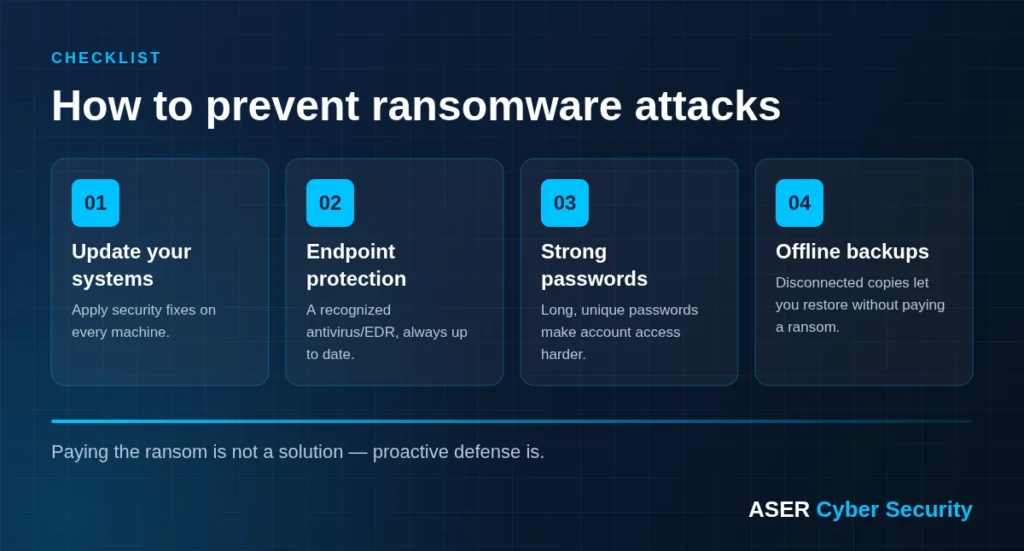
Paying a ransom is not a solution; proactive defense is.
Unfortunately for affected organizations, ransoms are often not a way out.
Staying quiet and giving in to cybercriminals' demands does not necessarily mean that a ransomware attack will go away.
In many cases, criminals still release stolen data, intentionally or accidentally, after successfully blackmailing a company.
For example, the ransomware Netwalker and Mespinozagroups have in the past published confidential data even though they received ransom payments from the organizations they breached. ‘Re-extortion’ is also sadly common.
The Sodinokibi ransomware group is known for threatening victims with data exposure even weeks after they paid the initial ransom.
More recently, there have been reports of criminals who allegedly broke away from ransomwaregroups, contacted previously extorted companies and threatened to leak information those companies had already paid to keep secure.
In some countries, paying a ransom may also be against the law.
In the United Kingdom, payers can be prosecuted under the Terrorism Act (2000) if the recipient is found to have links to terrorism.
???? Ransomware spreads through the network. The ASER NDR detects suspicious movement in traffic and helps isolate the attack quickly.
In conclusion.
Finally, even if paying cybercriminals does not break any law (for now), keeping an attack secret is still a mistake and can come back to haunt a business in the future.
That is exactly what happened to Uber after it paid cybercriminals US$100,000 in 2017 to keep quiet about a breach that exposed the personal information of 570,000 accounts.
When the incident inevitably came to light, Uber's CSO was fired and the company had to pay a US$148 million fine in the US and a £385,000 fine in Europe.
Consequently, instead of relying on ransom payments, organizations need to make sure an attack doesn't happen in the first place.
A preventive cybersecurity strategy that leverages deterministic solutions, together with an up-to-date approach to network security, is therefore mandatory.
Being hit by a ransomware attack can make organizations feel trapped, but with an efficient defense this doesn't have to be the case.
That's why you should always keep in mind that it is safer to opt for preventive security to avoid any kind of attack.
For this, count on ASER to deliver the best solutions for your systems; after all, we have the best specialists in cybersecurity.
Would your company withstand a ransomware attack?
For more than 20 years, ASER has protected Brazilian companies with 100% managed security. Talk to an expert and get a free assessment of your business risks.