
Data breaches, whether through physical or digital means, cause serious damage to any company today and can lead it to bankruptcy and cause major harm.
With technology advancing at a breathtaking pace, along with the growing number of computing advances and conveniences that technological devices bring to our lives, the number of potential threats is also growing exponentially.
One of the most serious harms any company can suffer is a data breach.
That's why security has always been the top priority for any organization.
However, nowadays it is a challenge to provide the level of security needed to eliminate the chance of potential data breach issues.
In this article, we look at what a data breach is, what its main consequences are and how to protect your business data against theft.
What is a data breach?
Data breaches occur when there is unauthorized access to highly confidential information.
There are different types of data breaches, including attacks such as ransomware, phishing, viruses, malware, DDoS and so on.
A data breach is a serious problem that can disrupt any business's operational processes, as well as negatively impact a brand's overall reputation and cause financial losses.
Considering that almost all the data companies hold is stored online, cybersecurity is a growing problem that every business needs to take seriously.
There are many high-level security measures you can take to prevent a data breach, from AI to incident response contingency teams.
However, if you own a small business, or simply want to know what you can do to prevent leaks, the best way to avoid an incident is to know how breaches happen.
Main vulnerabilities that lead to data breaches.
Before we cover the essential consequences of a data breach, let's better understand the main vulnerabilities that can lead to such a serious problem.
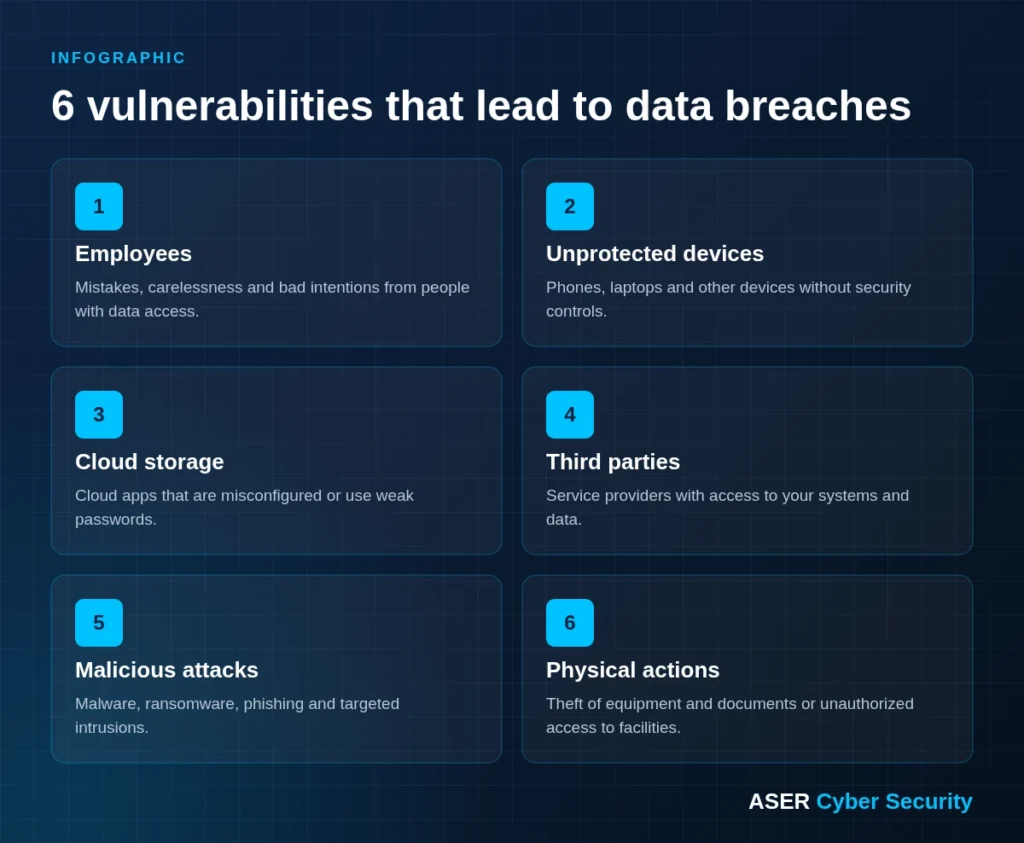
Employees.
Employees who have access to confidential data and are not familiar with security measures can increase the risk of insider attacks. That's why it's important to take care of security.
For example, dismissed employees should no longer have access to any internal information. It is also recommended to regularly check all employee accounts for suspicious activity.
Mobile and other unprotected devices.
If your employees use personal mobile devices for work-related processes, this increases the risk of data breaches.
Also, if your team brings their own laptops to work in the office, you'll have less security control over data transfer and storage, which can be a potential threat.
Cloud storage applications.
More and more companies are using cloud storage applications, which are very convenient because they let you access any data at any time from any device in seconds.
However, cloud solutions are prone to security threats and can be yet another channel for cyberattacks and data leaks.
Third-party service providers.
If you rely on third-party service providers, you also run a higher risk of a data breach. Since outsourcing is a cost-effective solution, many companies delegate some tasks, including the development of software, to other companies.
If that service provider's system isn't secure enough, all the data you provide is at greater risk of being stolen.
Malicious attacks.
Downloading malware from the internet can increase the risk of data breaches. This can happen when employees click suspicious links or visit untrustworthy websites.
An outdated operating system can also multiply the chances of a data leak.
Physical actions.
Although you may think cybercriminals are experienced hackers who only access data remotely, another common way of gaining access to sensitive data is actually through physical actions.
For example, criminals can steal a company's documents, laptops, phones or storage devices. They can also access physical assets and copy them without anyone knowing they were accessed.
Because of this, it's important to have effective control over who enters your company and what they do while they are there.
Your data may already be for sale
The ASER Cyber Threat Intelligence monitors the dark web, forums and leaks to warn your company before exposed credentials and data are used in an attack.
Effects and losses caused by a data breach.
Now that you're more aware of the main factors that can lead to data breaches, let's explore the main consequences of such an event for a company:
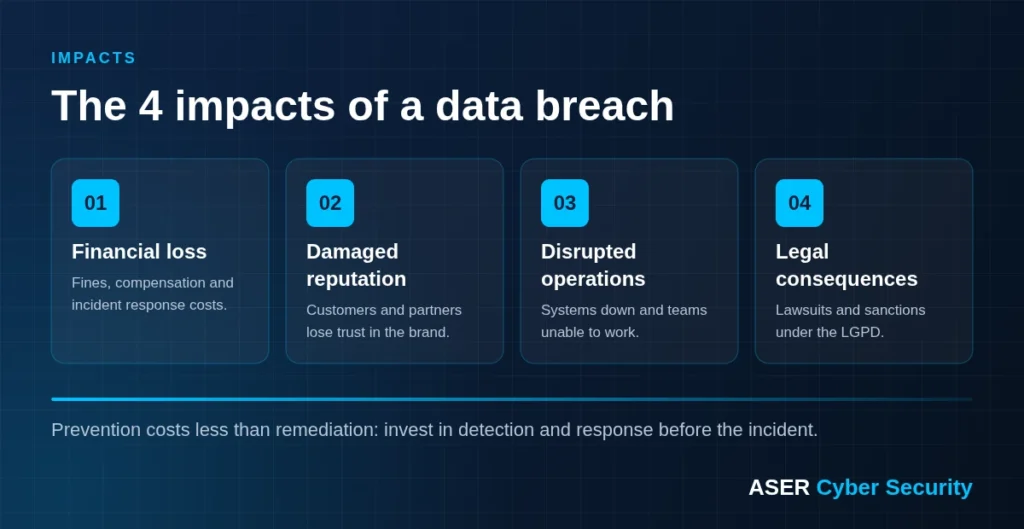
Financial loss.
Depending on its type, a data breach can be minor or very expensive and lead to significant financial loss, which is always harmful to a business.
A data leak will result in additional security costs, loss of market share value, as well as costs spent compensating affected customers. Here are the factors that make a data breach expensive for a company:
- By law, a company must inform the authorities and its customers in the event of a data breach. If the company breaks the law, it will have to pay regulatory fines;
- If a data leak involves confidential customer details, such as credit card information, the company may be subject to a costly lawsuit or have to pay other legal fees;
- To improve overall data security, the company will have to invest more in enhancing data security and protection;
The company may also lose many customers who will no longer trust its business, as we'll see below.
Although lost revenue is hard to calculate, one thing is clear: it will be large.
Damaged reputation.
News of the data leak will spread in the blink of an eye and negatively affect your brand's reputation. A data breach will result in a loss of customer trust, and the chances are high that they will never do business with you again.
In addition, affected users may also share their negative experiences with others. Such damage is immeasurable and devastating for any company.
It will not only drive away existing and potential customers, but also negatively affect stakeholder retention and the company's image as an employer.
It will be much harder to attract the best talent in the industry, and you will certainly have difficulty finding investors later on.
Given that a damaged reputation is hard to recover, a company will have to spend extra on public relations and marketing to restore its public image, regain trust, nurture leads and increase its revenue.
Disruption of operational processes.
A data breach is a serious problem that takes time not only for recovery but also for investigation. During this period, all business operational processes will be negatively affected.
Certain types of data leaks can result in the loss of essential business information that halts any operational process.
Companies that have suffered such serious data breaches usually shut down all operations until the cause and recovery plan are defined. It's important to find the source of the breach and the solution to fight its consequences.
In turn, suspending all operations will lead to a significant loss of customer base and, accordingly, revenue. On average, it takes about six months for a company to get back on track after a cyberattack involving a data breach.
Legal consequences.
Another devastating effect of a data leak is the significant legal consequences that can cause many problems.
As mentioned, if your customers' confidential personal information is involved in a data leak, it may result in a class action lawsuit.
In that case, a company will be required to pay compensation to the victims through a lawsuit.
All legal and settlement fees are extremely expensive, and you will face many expenses.
Sometimes a company may even be barred from any business operation until a legal investigation is complete.
????️ Fast detection reduces the damage. The ASER SOC monitors your environment 24×7 and responds to incidents before they become a data breach.
Final thoughts.
As you can see, data breaches are a serious security problem that must be handled with great focus and attention.
Any business can face this problem, and the effects can be devastating.
Dealing with a cyberattack is expensive.
It can also damage your overall reputation and your internal and external operational processes, and cause lost revenue and loss of customer trust.
Therefore, it is extremely important to ensure the highest level of security to reduce your risk of data breaches and protect all your confidential information.
Count on our specialists to raise the security level of your operating systems.
ASER provides the best cybersecurity solutions.
Is your company prepared to prevent a data breach?
For more than 20 years, ASER has protected Brazilian companies with 100% managed security. Talk to an expert and get a free assessment of your business risks.