
The new era of technology and risk: with the growth of 5G networks, a new era of interconnectivity will become a reality with the Internet of Things (IoT)
5G technology and the Internet of Things (IoT) have arrived in full force. This new era of interconnectivity is already a reality and promises to bring even more convenience and innovation to our daily lives.
In general, 5G and the Internet of Things can be implemented in many aspects of a business; it will depend on each company's strategic planning.
It's also worth noting that both can be adapted to organizations of any size, small or large. That's because one interesting aspect of these technologies is scalability.
This is therefore an important quality for maintaining high performance in a context of expansion, whether planned or not. After all, a company's technology needs to keep up with its growth or downsizing.
Here are some process opportunities that can be optimized with 5G and Internet of Things technologies:
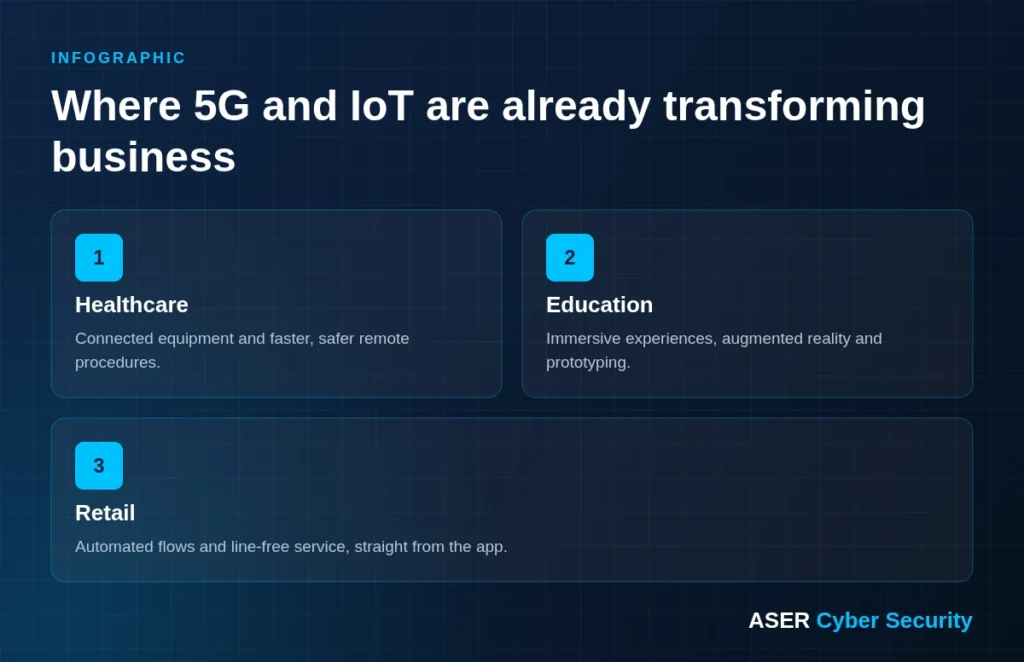
Healthcare
5G and IoT are already present in healthcare, especially in the development of new technologies for surgeries and complex treatments.
For example, the use of mechanical arms and minimally invasive equipment helps professionals perform difficult procedures.
However, with 5G connectivity, many processes can be carried out remotely, saving time and resources.
In addition, the connection between robotic and mechanical equipment that makes medical routines more accessible and straightforward also relies on network connectivity.
And if it is more stable, it will allow safer procedures.
Education
In education, we see opportunities to boost students' active learning.
That's because, according to many experts, people learn more through practice and by teaching others. In addition, we have a cognitive load limit that cannot be exceeded when absorbing knowledge.
The expectation, therefore, is that together, 5G and IoT can deliver a more immersive and, consequently, more stimulating experience for students — from primary school to higher education.
In engineering courses, for example, augmented reality and 3D printing can already be used for prototyping projects. As both technologies spread, however, these advances are expected to go further, since the cost of these solutions will also fall.
Retail
In retail, 5G and IoT have fertile ground. They can be applied to optimize operational flows and deliver a differentiated customer experience.
One example is Localiza's Fast service, where customers rent a car through the app without going through the counter. Pickup confirmation and unlocking are done via the app.
That's just one example of how IoT can be applied in retail. There are other ways, such as connecting your product or service to voice assistants.
In smart homes, for example, users can lock the security system by voice command from anywhere in the world.
In other words, besides the benefits of a connected company, your business managers will get a first contact with IoT, which will make it easier to identify opportunities for application, adaptation and innovation.
But Is It Really Secure?
There is also concern about the security of the network itself, which can be much more complicated to manage.
5G represents a major threat, partly because there are more points through which cybercriminals can attack, such as breaking into IoT devices, for example.
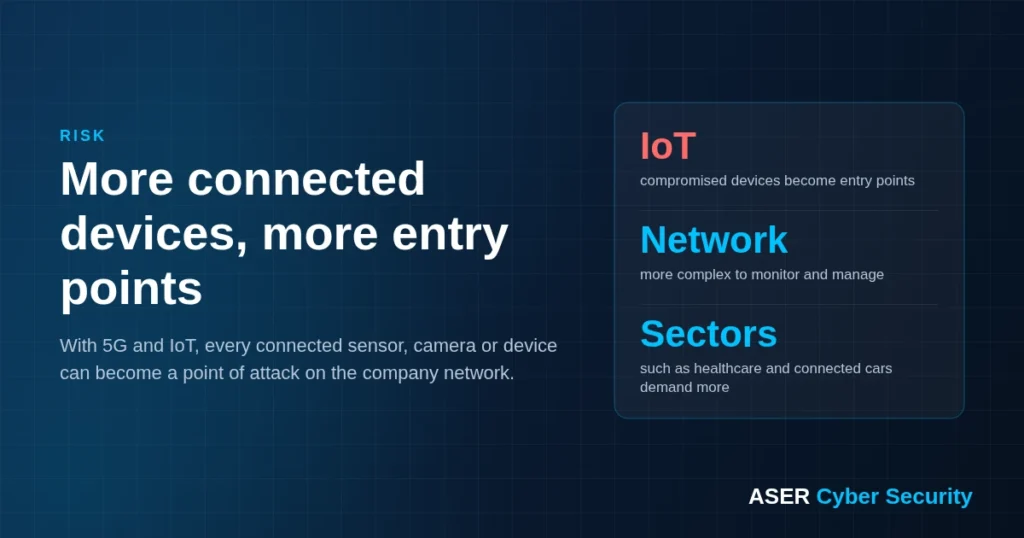
The challenge is amplified for vertical 5G use cases, such as connected cars and healthcare, which bring industry-specific security requirements.
As the threat landscape expands, 5G security is certainly a complex task. But if the ecosystem solves the problems, the technology will be more secure thanks to better encryption than 3G and 4G.
In many ways, 5G is a shared responsibility model, much like cloud services. Companies are responsible for transporting data across the networks.
But mobile network operators must take a continuous, risk-based approach to monitoring their network and services, developing security controls around emerging threats.
Do you know which devices are connected to your network?
The ASER NAC identifies and controls every device — including IoT — and applies the right access policy to each one.
Even with so many conveniences in daily life, it is important to highlight that the great advantage 5G will bring to the market is the possibility of creating new business segments, driving an increasingly connected world.
In short, the speed of 5G will mark a very important path in an increasingly connected world.
It will bring changes that support the progress already made, as well as enabling advances in research and development.
Take the opportunity to read our other articles on the site.
Always keep your data secure and check for vulnerabilities.
Talk to our specialists!
Is your network ready for the 5G and IoT era?
For more than 20 years, ASER has protected Brazilian companies with 100% managed security. Talk to an expert and get a free assessment of your business risks.