
Due to the rise in ransomware attacks in Brazil, the only way out is a bill that helps and supports people when they suffer this type of attack.
Public services, private companies and celebrities are among the main victims of ransomwareattacks, whose data was hijacked and publicly leaked online.
Because of this growing problem, a bill was recently created to define and criminalize these cyberattacks.
A recent survey by Palo Alto Networks shows how serious the problem was last year (2021).
The survey found an 85% increase in victims of ransomware attacks compared to the previous year (2020).
With this scenario in view, Bill No. 879/2022, authored by Senator Carlos Viana (PL-MG), seeks to criminalize data hijacking, imposing prison sentences of 3 to 6 years on offenders.
If data hijacking is carried out to obtain a ransom payment or any other illicit advantage, the perpetrator will be charged with an aggravated crime. In that case, the sentence will be increased to up to 8 years.
What do the experts who helped draft the bill say?
The bill proposed by the legislator was drafted with the help of lawyer and digital law specialist Patrícia Peck.
The specialist states that the legislative text also aims to amend the Penal Code to punish more effectively, with prison sentences of 2 to 5 years (plus a fine), the invasion of any electronic device that results in obtaining personal data.
A ransomware it is a violation of privacy, a right guaranteed to citizens by the Federal Constitution.
The bill is currently being processed in the Federal Senate Plenary.
However, until the bill is approved, companies need to know how to protect themselves from these attacks and learn about the seriousness of the problem.
What is a Ransomware?
Ransomware is a piece of software that maliciously encrypts files using a key known only to the malwareoperator, who then demands a ransom in exchange for providing the key to decrypt the data.
The ransom demand usually asks for payment in an untraceable cryptocurrency.
If the victim pays, they usually, though not always, receive the key and can therefore recover the lost data.
The most commonly found variants last year included REvil/Sodinokibi, Hades and DoppelPaymer, although one of the most impactful attacks of the year was carried out by the cybercriminal group Darkside.
This attack, against Colonial Pipeline, disrupted fuel supply to the US East Coast for a week in May and resulted in a ransom payment of 75 bitcoins, equivalent to US$4.4 million at the time the ransom was paid.
What causes ransomware?
The ransomware relies on an existing vulnerability to infiltrate a target system.
The most common infiltration methods are phishingattacks, brute-force attacks, attacks against insecure RDP services and the exploitation of vulnerabilities in software.
For example, the REvil/Sodinokibi ransomware spread through brute-force attacks and server exploits, among other methods.
Initially, it used a vulnerability in Oracle WebLogic to download the code that encrypts the victim's files, but the method used changes over time because ransomware is constantly evolving as criminals seek to exploit new vulnerabilities.
Can data encrypted by Ransomware be recovered?
Companies should assume that once their data is encrypted by ransomware, in most cases it cannot be recovered.
Ransomware uses sophisticated cryptographic technology that cannot be reversed without the key.
In the past, security experts managed to reverse the encryption of ransomware variants with flawed code, but this is unlikely to happen again with today's ransomware variants.
In some cases, including REvil/Sodinokibi, law enforcement agencies managed to identify and infiltrate the infrastructure of the ransomwareoperator, allowing them to extract the master key and build the decryption software tool.
However, this rarely happens within a time frame acceptable to businesses, and the most likely outcome of a successful attack is that the data is irretrievably lost unless the victim pays a ransom and the attacker provides a decryption key.
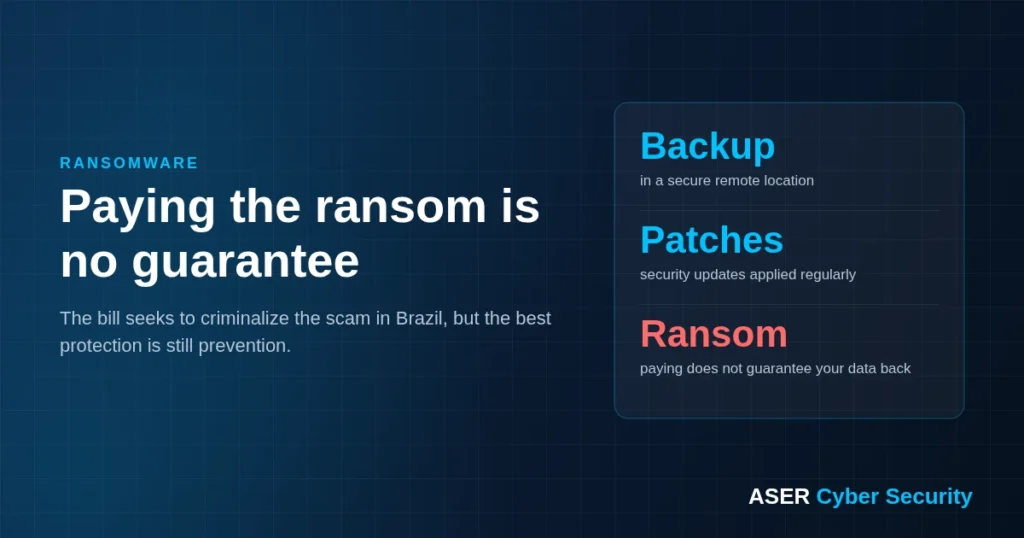
And there is no guarantee the data will be recovered even if the ransom is paid.
Should companies pay a Ransomware?
The temptation to pay a ransom is understandable, especially if your company is facing severe disruption because critical data is no longer available to employees or customers.
Many companies choose to pay. But, as mentioned earlier, companies that pay get only some of their data back; only a small group of lucky ones, if there is any luck in it, get everything back.
In addition, attackers can copy your data. And it is increasingly common for ransomware attackers to sell or release stolen data.
In fact, some attackers don't encrypt the data at all. They steal it and promise to delete what they stole if a ransom is paid — needless to say, criminals aren't always honest, right?
The FBI advises companies not to pay ransoms for the reasons we discussed. It also encourages companies to report ransomware attacks to the Internet Crime Complaint Center.
Regular risk assessments are part of prevention
The ASER Vulnerability Management gives your company continuous visibility into its flaws and remediation priorities.
How to prevent ransomware: 6 protection best practices.
Once the only copy of a company's data is encrypted by ransomware, its options are limited. Therefore, it is better to prevent infection in the first place and make sure important data is copied to a location that ransomware cannot reach.
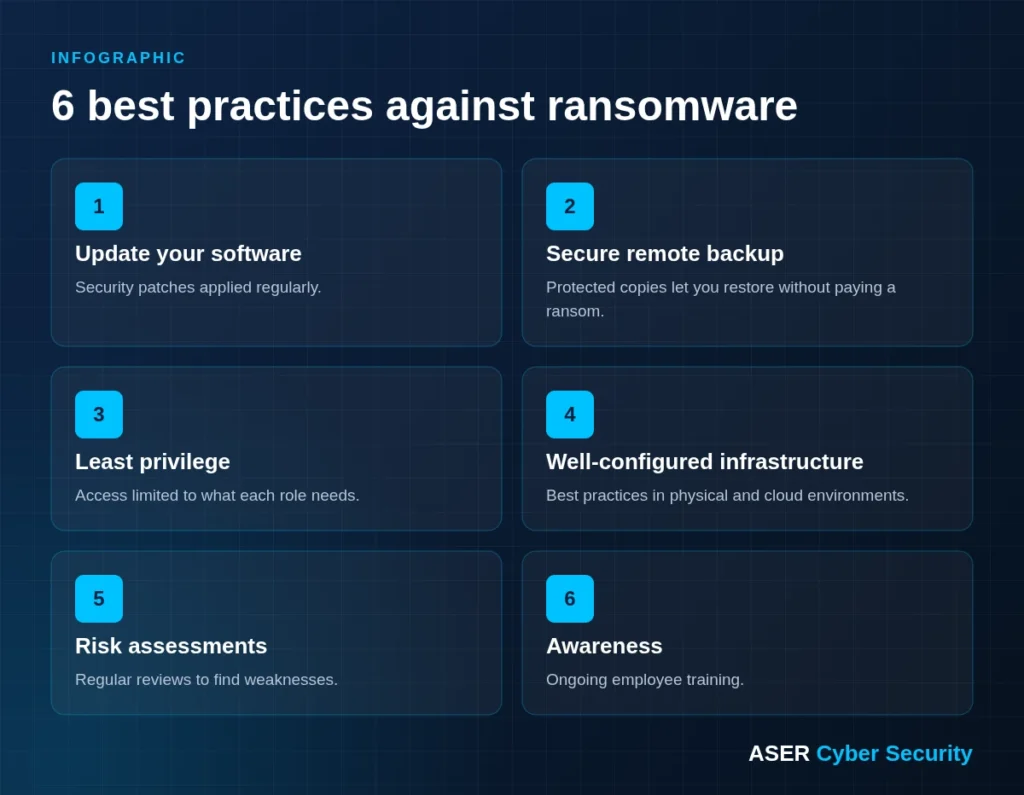
1. Regularly update software to apply security patches
Many ransomware infections start with vulnerabilities in software. The attacker exploits the vulnerability to gain access to a network and then uses that access to infiltrate your system.
It is not possible to guarantee that a system is free of exploitable vulnerabilities, but regularly updating software ensures that known vulnerabilities are fixed.
To highlight the importance of regular software patches: the EternalBluevulnerability, widely exploited by the catastrophic WannaCry ransomwarecampaign, had been fixed by a software patch months before the attacks began.
Victims were vulnerable because they hadn't updated their software in time.
2. Back up data to a secure remote location
The ransomware is effective because it deprives companies of the data assets they need. But that can't happen if the data also exists in a secure off-site location that the malware cannot access.
Ransomware that is sophisticated can find and encrypt local backups on connected systems, so an effective backup must copy data to a system that is not easily accessible from the local network.
So if the company has an up-to-date backup, it can simply wipe the infected systems and restore them, or deploy its disaster recovery infrastructure in the cloud with its applications and backup.
3. Implement least-privilege access policies
Data should be accessible only to the users and services that need it.
The more people have access, the more likely it is that credentials will be leaked or stolen. So if an individual no longer needs access, revoke their permissions.
Limit permissions to those that are necessary. For example, if a user needs to see information but not change it, make sure they have only read permissions, not write permissions, on the database, disk or cloud storage service that holds the data.
4. Follow best practices for physical and cloud infrastructure configuration
Cloud configuration errors often lead to vulnerabilities that a ransomware attacker can exploit.
For example, incorrectly configured access permissions on AWS S3 buckets can allow ransomware attackers to download, edit and delete data.
That's why you should make sure your company follows industry best practices for data security. If your company lacks the expertise to protect its data, hire a professional who can assess your security implementation and provide guidance.
5. Perform regular security risk assessments
The ransomware usually happen because a company doesn't understand the risks associated with its behavior or system implementation.
The EternalBlue example discussed above is a useful illustration;
Most companies know that updating software is a good idea, but choose not to because they don't understand the seriousness and potential cost of living with that risk.
The assessments of risk help companies understand potential security threats, including threats that could lead to a successful attack.
6. Implement security awareness training
The phishing are one of the most exploited ransomware vectors. Attackers send an email to employees or managers containing a link.
This link takes the target to a site that infects their system with malware or tricks them into entering authentication credentials.
One way to fight phishing is to make sure employees recognize the signs. To achieve this, you'll need to train every employee who could pose a risk.
???? Awareness training in practice. The ASER Phishing Platform simulates real attacks and measures your team's progress.
What to expect from the future?
The short answer is that ransomware isn't going away anytime soon.
We'll probably keep seeing criminals become increasingly prepared to inflict maximum trouble and disruption on private companies and public services for some kind of financial gain.
In addition, attacks are becoming more sophisticated. They therefore require increasingly sophisticated solutions to detect them, and for cyber defense companies it is becoming harder and harder to mitigate problems in a timely manner.
For this and other reasons, the approval of Bill No. 879 of 2022 could be a good start for punishing these criminals and mitigating the problem through state enforcement.
But until the bill is approved, it is important for your company to work with a company that performs penetration and vulnerability testing so you can avoid problems with cyberattacks.
Count on ASER and our specialists to help your company maintain its cybersecurity.
Is your company protected against ransomware?
For more than 20 years, ASER has protected Brazilian companies with 100% managed security. Talk to an expert and get a free assessment of your business risks.